Sieve of Eratosthenes
I first encountered the Sieve of Eratosthenes while reading an editorial to a competitive programming problem. The problem required me to be able to quickly determine prime numbers, and I kept trying to use the naive approach:
bool isPrime(int n)
{
    if (n < 2)
        return false;
    for (int i = 2; i * i <= n; i++)
        if (n % i == 0)
            return false;
    return true;
}
After around an hour of being stuck, and having never seen the Sieve before, I actually smiled when I saw the editorial use it; I never even considered something so simple (not to imply that the algorithm is easy to spot at first glance).
Since then, I've read the Art of Problem Solving: Introduction to Number Theory textbook by Mathew Crawford, and I've made sure to keep the algorithm in my utility functions.
Algorithm Description
The algorithm for the Sieve is as follows:
Let be the maximum number that primes will be generated up to.
- Set 0 and 1 to not prime
- Set every number to prime
- Iterate from to :
- if the current iteration is a prime number, then set every multiple of up to as not prime
With a time complexity of , this algorithm efficiently generates prime numbers (see this for a proof).
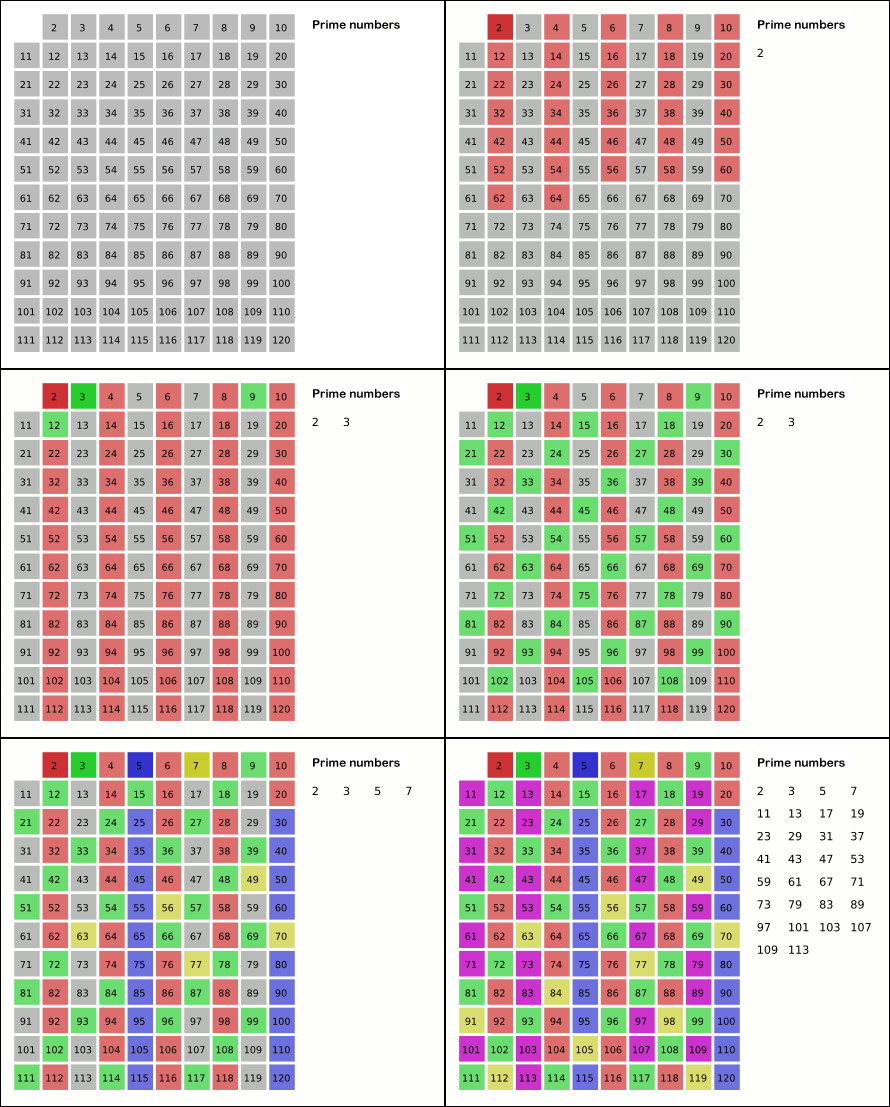
GIF source: Wikipedia
/**
 * Sieve of Eratosthenes for primes up to n.
 * Time complexity: O(n log log n)
 * @param n maximum value
 * @return vector<bool> of size n+1, true at prime indices
 */
vector<bool> sieveOfEratosthenes(int n)
{
    vector<bool> isPrime(n + 1);
    for (int i = 2; i <= n; i++)
    {
        isPrime[i] = true;
    }
    for (int i = 2; i * i <= n; i++)
    {
        if (isPrime[i])
        {
            for (int j = i * i; j <= n; j += i)
            {
                isPrime[j] = false;
            }
        }
    }
    return isPrime;
}